
Home Housing Issues

Housing · State and local

Housing Issues

With the multiple housing bills signed into law over the last few years, including SB 330, Sacramento now decides much of what gets built in Morgan Hill, and how. This page explains some of the state laws behind those decisions and shows what is still decided here at home.

Housing bills signed into law in recent years
~150
New housing measures enacted in 2025 alone
~50
Voters who approved Measure S in 2016
77%
Measure S growth limits suspended through
2030

Watch · 3½ minutes

Morgan Hill's state housing goal, explained

Every eight years, the state sets how many new homes each city must plan for. This short video walks through what that means for Morgan Hill and why the city can't simply say no to projects that follow the rules.

New homes Morgan Hill must plan for, 2023–2031
1,037
Of those, homes that must be affordable
587
Share of new homes the inclusionary rule requires to be affordable
15%

What you'll learn

  • How the state goal is split between very low, low and moderate income homes
  • Why market-rate projects alone can't close the gap in affordable homes
  • How the Housing Accountability Act protects projects that meet city standards
  • The one narrow exception that lets a city deny a project
Read the video transcript

Every eight years, the State of California gives every city and county a housing target. It's called RHNA, the Regional Housing Needs Allocation. For the 2023 to 2031 cycle, Morgan Hill must plan for 1,037 new homes. And the state doesn't just set the total. It tells us who those homes must serve. 587 of those homes must be affordable: 413 for very low and low-income households, and 174 for moderate-income households. These are the families, seniors, and workers who keep our city running.

So how do those homes get built? When a developer builds in Morgan Hill, our inclusionary housing rules require 15% of the homes to be affordable. Build 100 homes, and 15 must be affordable.

Let's do the math. A builder proposes 1,000 homes. That's 150 affordable units, and we're still 437 short. A second builder adds 1,000 more. Now we have 2,000 homes, but only 300 are affordable, still 287 short. A third project brings us to 3,000 homes and 450 affordable units, still 137 short. It takes a fourth project, nearly 4,000 homes in all, to finally get there.

And it's even harder than that. Each income level has its own target. In for-sale neighborhoods, the required affordable homes are priced for moderate-income buyers, so they can't help meet the 413 very low and low-income homes at all.

That's the challenge. To meet the state's affordable goals through private development alone, a city would have to approve 3 to 4 times the homes the state actually asked for, along with all the roads, schools, water, and services that growth requires.

Which brings up a common question: once a city meets its RHNA numbers, can it just stop building? The short answer is no. RHNA is a minimum, not a ceiling. The state says it should never be treated as a cap, or as a reason to deny housing.

California's Housing Accountability Act, Government Code Section 65589.5, protects housing projects that meet a city's objective zoning and design standards. A city can deny one, or cut its density, only if it finds a specific, unavoidable threat to public health or safety that can't be mitigated.

Meeting RHNA opens just one narrow door. A city with a compliant housing element may deny an affordable project only in an income category where it has already met its goal, and not if the project includes any category that still falls short. So even after the numbers are met, projects that follow the rules keep moving forward.

The California State Legislature continues to pass more and more housing bills that make it more and more difficult on cities like Morgan Hill.

Sources shown in the video: Cal. Gov. Code § 65589.5 (Housing Accountability Act); California Department of Housing & Community Development; Morgan Hill Housing Element, 2023–2031.

Sources: Cal. Gov. Code § 65589.5 (Housing Accountability Act), California Department of Housing & Community Development, Morgan Hill Housing Element 2023–2031. Informational only; not legal advice. Narration voice generated with AI.

Advocacy

Letters to Legislators

Letters I've sent or signed asking state leaders to change course on housing policy, plus my op-ed on how state housing laws are affecting Morgan Hill.

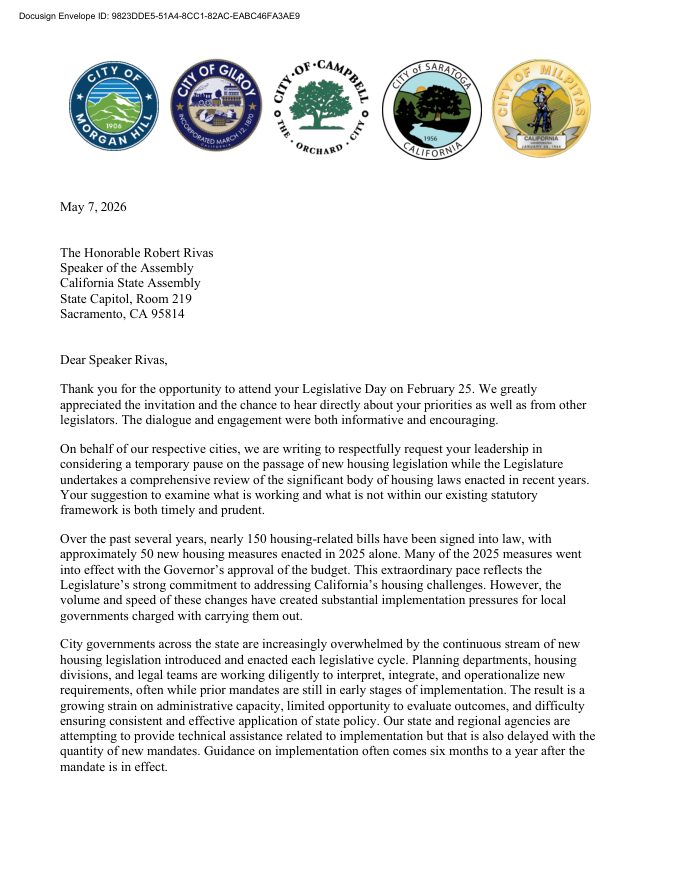
First page of the May 7, 2026 joint letter to Speaker Robert Rivas

· Joint letter · 2 pages

Request for a two-year pause on new housing legislation

To: The Honorable Robert Rivas, Speaker of the California State Assembly

Signed by: Mayors Mark Turner (Morgan Hill), Greg Bozzo (Gilroy), Daniel E. Furtado (Campbell), Chuck Page (Saratoga) and Carmen Montano (Milpitas)

Nearly 150 housing bills have become law in recent years, about 50 in 2025 alone. Cities are still putting earlier mandates in place when new ones arrive, and state guidance often comes six months to a year after a law takes effect. The mayors asked the Speaker to pause new housing laws for two years while the Legislature reviews what is working.

What the letter asks the Legislature to do

  • Review housing laws passed within the last four years
  • Evaluate measurable outcomes and unintended consequences
  • Identify redundancies, conflicts, or areas requiring clarification
  • Assess administrative and fiscal impacts on local jurisdictions
  • Strengthen and refine existing statutes where necessary
“A deliberate pause would not signal retreat from the state’s housing goals. Rather, it would demonstrate a commitment to thoughtful governance and evidence-based policymaking.”
Read the letter as text

May 7, 2026

The Honorable Robert Rivas
Speaker of the Assembly
California State Assembly
State Capitol, Room 219
Sacramento, CA 95814

Dear Speaker Rivas,

Thank you for the opportunity to attend your Legislative Day on February 25. We greatly appreciated the invitation and the chance to hear directly about your priorities as well as from other legislators. The dialogue and engagement were both informative and encouraging.

On behalf of our respective cities, we are writing to respectfully request your leadership in considering a temporary pause on the passage of new housing legislation while the Legislature undertakes a comprehensive review of the significant body of housing laws enacted in recent years. Your suggestion to examine what is working and what is not within our existing statutory framework is both timely and prudent.

Over the past several years, nearly 150 housing-related bills have been signed into law, with approximately 50 new housing measures enacted in 2025 alone. Many of the 2025 measures went into effect with the Governor’s approval of the budget. This extraordinary pace reflects the Legislature’s strong commitment to addressing California’s housing challenges. However, the volume and speed of these changes have created substantial implementation pressures for local governments charged with carrying them out.

City governments across the state are increasingly overwhelmed by the continuous stream of new housing legislation introduced and enacted each legislative cycle. Planning departments, housing divisions, and legal teams are working diligently to interpret, integrate, and operationalize new requirements, often while prior mandates are still in early stages of implementation. The result is a growing strain on administrative capacity, limited opportunity to evaluate outcomes, and difficulty ensuring consistent and effective application of state policy. Our state and regional agencies are attempting to provide technical assistance related to implementation but that is also delayed with the quantity of new mandates. Guidance on implementation often comes six months to a year after the mandate is in effect.

A deliberate pause would not signal retreat from the state’s housing goals. Rather, it would demonstrate a commitment to thoughtful governance and evidence-based policymaking. Taking the next two years to refrain from enacting additional housing statutes would provide the Legislature, in partnership with local governments and stakeholders, with the opportunity to:

  • Review housing laws passed within the last four years
  • Evaluate measurable outcomes and unintended consequences
  • Identify redundancies, conflicts, or areas requiring clarification
  • Assess administrative and fiscal impacts on local jurisdictions
  • Strengthen and refine existing statutes where necessary

Such a review would help ensure that California’s housing framework is coherent, effective, and sustainable. It would also allow local municipalities to focus on full and faithful implementation of existing mandates rather than continuously adjusting to new ones.

Your leadership in advancing a structured review process could foster collaboration between the State and local governments, strengthen public confidence, and ultimately produce more durable and impactful housing policy.

Thank you for your continued commitment to addressing California’s housing needs and for considering this request. We appreciate your thoughtful attention to this matter and your ongoing service to the people of California.

Sincerely,

  • Mark Turner, City of Morgan Hill Mayor
  • Greg Bozzo, City of Gilroy Mayor
  • Daniel E. Furtado, City of Campbell Mayor
  • Chuck Page, City of Saratoga Mayor
  • Carmen Montano, City of Milpitas Mayor

Response No response posted yet.

· Op-ed · Morgan Hill Times

California’s housing laws create chaos in our communities

State laws like SB 35 and AB 2097 cut or eliminate on-site parking for new housing near transit. In a city with limited transit like Morgan Hill, that pushes cars into neighborhoods, blocks driveways and emergency access, and strains everyone’s patience. I call on Sacramento to stop using one-size-fits-all rules and to give local leaders a seat at the table.

“It’s time for Sacramento to listen. Our communities deserve a seat at the table when decisions are made that directly affect our streets, our safety and our quality of life.”

City position on various housing legislation

Positions the City of Morgan Hill has formally submitted to the State Legislature on housing and land-use bills since I took office in December 2022. The newest session is listed first.

City of Morgan Hill positions on state housing legislation
BillWhat it doesSessionCity position
AB 1751 Missing Middle Townhome Ownership ActRequires cities to allow more townhome-style housing in existing neighborhoods 2025–26 Oppose
AB 1621 Permits after approval; Housing Accountability ActLimits city review of housing projects after they are approved 2025–26 Oppose
SB 1117 Accessory dwelling units (ADUs)Expands state rules for backyard units and junior ADUs 2025–26 Oppose
SB 79 Transit-oriented housingAllows taller, denser housing near transit stops regardless of local zoning 2025–26 Oppose
AB 650 Housing element and RHNA processChanges how state housing goals are assigned and reviewed 2025–26 Support
AB 3035 Farmworker housingHelps build housing for agricultural workers 2023–24 Support
SB 423 Streamlined multifamily approvalsExtends and expands fast-track approval of multifamily housing (SB 35) 2023–24 Oppose
AB 480 Surplus landChanges rules for how cities sell or lease public land 2023–24 Oppose

Positions as recorded in legislative committee analyses and compiled by CalMatters Digital Democracy. Bill summaries are simplified for readability.

Future letters to legislators will be added here, newest first, each with the date, who it went to, a short summary and the full PDF.

California housing mandates

The 20 state laws with the biggest local impact

These state laws have taken over decisions that used to be made in Morgan Hill. Select a law to read the summary.

Download the full list (PDF)
Showing all 20 laws
01GROWTH CAPS PREEMPTEDHousing Crisis ActSB 330 (2019) + SB 8 (2021)Zoning & local control

Bans numeric growth caps, population ceilings and downzoning, limits a city to five hearings on a housing project, and freezes the standards and fees in effect when a preliminary application is filed, sets a timeline where a decision must be made. This is the law that suspended Morgan Hill's voter-approved Measure S growth control system, the 215-unit annual limit and 58,200 population ceiling are unenforceable through January 1, 2030.

02NO HEARING, NO CEQAMinisterial streamliningSB 35 (2017) → SB 423 (2023)Morgan Hill currently exemptApprovals without hearings

Requires ministerial, CEQA-exempt approval of qualifying multifamily projects in cities that miss their housing production targets or lack a compliant housing element. SB 423 made the program permanent and expanded it, so eligible projects move forward with no design hearing, no planning commission review and no council vote. Based on housing projection, Morgan Hill is currently exempt from this law.

03ZONING SET ASIDEBuilder's RemedyAB 1893 + AB 1886 (2024)Approvals without hearings

AB 1886 confirms a housing element is compliant only when HCD says so, and AB 1893 bars cities from denying qualifying builder's remedy projects, limiting review to objective standards already on the books. A short lapse in housing element compliance now exposes a city to applications that ignore its zoning entirely.

04STATE-SET HEIGHT AND DENSITYTransit-Oriented DevelopmentSB 79 (2025)Morgan Hill currently exemptZoning & local control

Makes qualifying transit-oriented housing an allowed use near specified transit stops in urban transit counties, including Santa Clara County, at state-mandated density and height floors. It takes effect July 1, 2026, and HCD reviews each local implementing ordinance or alternative plan for substantial compliance. Morgan Hill is exempt from this law based on our existing transit service levels.

05LOCAL CODES FROZEN TO 2031CEQA overhaul and code freezeAB 130 + SB 131 (2025)Approvals without hearings

Signed as budget trailer bills on June 30, 2025, they create a statutory CEQA exemption for infill housing on sites up to 20 acres and exempt housing element rezoning actions. They also freeze new state and local residential building standards from October 2025 through June 2031, taking local reach codes and green building amendments off the table. This law also includes an aggressive timeline and automatic approvals if required timeline is not met.

06COMMERCIAL LAND REZONEDHigh Road Jobs ActAB 2011 (2022) + AB 2243 (2024)Zoning & local control

Allows by-right, CEQA-exempt housing on commercial and office-zoned corridor sites at state-set density and height in exchange for affordability and prevailing wage. AB 2243 widened the eligible sites, effectively rezoning a city's retail corridors with no general plan amendment and no economic development analysis.

07FOUR UNITS ON AN R-1 LOTDuplexes and lot splitsSB 9 (2021) + SB 450 (2024)ADUs & lot splits

Requires ministerial approval of duplexes and urban lot splits in single-family zones, allowing up to four units where one home stood. SB 450 removed several local safeguards and added a 60-day decision clock, so staff are required to process these with no discretion, no hearing and no neighbor notice.

08EVERY LOT UPZONEDAccessory dwelling unitsADU laws, 2019–2024 (AB 68/881/587, SB 897, AB 1033, AB 1332, AB 2533)ADUs & lot splits

Successive bills eliminated lot-size minimums, owner-occupancy rules, most setbacks and parking; raised height limits; allowed ADUs to be sold as condominiums; required pre-approved plan programs; and forced amnesty for unpermitted units. Homeowner’s Associations are not allowed to deny an ADU. Together they have rewritten every residential zone in the municipal code, and the Legislature revisits them nearly every year.

09UP TO EIGHT PER LOTADUs on multifamily lotsSB 1211 (2024)ADUs & lot splits

Raises the ministerial allowance from two to as many as eight detached ADUs on a lot with an existing multifamily building, capped at the number of existing units, with setbacks of no more than four feet. Replacement parking cannot be required, so an existing fourplex can double or quadruple with no hearing and no parking.

10$10K–$50K PER MONTHAttorney General penaltiesSB 1037 (2024)Deadlines, penalties & fees

Effective January 1, 2025, courts must impose civil penalties of $10,000 to $50,000 per month per violation against cities, including charter cities, in suits brought by the Attorney General or HCD over housing element compliance or failure to approve ministerially. Penalties are mandatory rather than discretionary and accrue from the first violation.

1160-DAY DEADLINESPost-entitlement shot clocksAB 2234 (2022)Deadlines, penalties & fees

Sets hard deadlines for building and post-entitlement permits — 30 days for completeness, 60 days for projects under 25 units — plus online submittal requirements. For a department with a handful of plan checkers, a missed deadline creates legal exposure regardless of workload.

12COMPLIANCE OR PENALTYCompliance or penaltyHousing element rigor, 2017–2022 (AB 1397, AB 686, AB 1398, SB 197)Deadlines, penalties & fees

AB 686 imposed an affirmatively furthering fair housing duty across all local land use actions; AB 1397 tightened site inventory realism; AB 1398 and SB 197 require rezoning within one year and impose streamlining as an automatic penalty for lateness. The housing element is no longer a plan, it is an enforceable compliance instrument.

13NO PARKING REQUIREDParking minimumsAB 2097 (2022)Zoning & local control

Prohibits cities from imposing minimum parking requirements on most development within a half mile of major transit, including commercial and industrial uses as well as residential. This generates more resident complaints than any other bill on the list, because spillover parking is immediate and visible and staff no longer have authority to mitigate it.

14MAPS OVER THE COUNTERStarter Home Revitalization ActSB 684 (2023) + SB 1123 (2024)Approvals without hearings

Requires ministerial, no-hearing, no-CEQA approval of subdivisions up to 10 parcels and 10 units, with a 60-day deemed-approved clock; SB 1123 extended it to vacant single-family lots effective July 1, 2025. Tentative maps, historically the core discretionary act of a planning commission, are now processed over the counter.

15OFFICE AND RETAIL SITESMiddle Class Housing ActSB 6 (2022)Zoning & local control

Makes residential use allowable on parcels zoned for office, retail or parking at the housing element default density, subject to prevailing wage and skilled workforce standards. It means a small city's entire commercial land inventory is effectively dual-zoned for housing whether the general plan says so or not.

16FAITH-OWNED LANDYes In God's BackyardSB 4 (2023)Zoning & local control

Allows by-right, 100 percent affordable housing on land owned by religious institutions and nonprofit colleges regardless of the underlying zoning, at state-set densities. In a city like Morgan Hill this quietly makes a scattered set of church-owned parcels developable at urban densities.

17STANDARDS WAIVEDDensity bonus escalationAB 1287, AB 2334, AB 1218 (2022–23)Zoning & local control

For projects that qualify under this law, AB 1287 permits a second stacked density bonus for additional moderate-income units, pushing total bonuses well past 100 percent; AB 2334 removed density caps in high-opportunity areas; AB 1218 tightened replacement-unit and anti-demolition rules. Concessions and waivers now routinely override the height, setback and open space standards that survived every other law here.

18FEES COLLECTED LASTImpact fee deferralSB 937 (2024) + SB 499 (2025)Deadlines, penalties & fees

Bars collection of most development impact fees until final inspection or certificate of occupancy, locks the fee amount to an earlier date, and extended qualifying entitlements by 24 months. Cities now build infrastructure years before the fee revenue arrives and carry the collection risk if a project stalls.

19BULK LIMITS VOIDEDHOME Act, floor area ratioSB 478 (2021)Zoning & local control

Prohibits floor area ratio limits below 1.0 on lots zoned for three to seven units and 1.25 on lots zoned for eight to ten, and bars lot coverage or minimum lot size rules that would preclude those densities. It is the quiet one that undoes the massing standards cities used to make small multifamily fit an existing neighborhood.

20BY-RIGHT SITINGShelters and navigation centersAB 101 (2019) + AB 2339 (2022)Approvals without hearings

AB 101 made low-barrier navigation centers a by-right use in mixed-use and nonresidential zones with a 30-day approval clock, and AB 2339 requires housing elements to identify shelter sites in zones with real capacity. Siting decisions once among the most deliberative a council could make are now ministerial or pre-committed.

Informational summary only; not legal advice. Current through August 2026. Topic groupings were added for this page.

Frequently asked questions

Questions I hear most

Why didn't the city hold a hearing on this project?

Under SB 35/SB 423, SB 9, SB 684/SB 1123 and AB 2011, qualifying projects are approved ministerially. A ministerial permit is a checklist, if the application meets the objective standards, staff must issue it. There is no hearing, no vote and no appeal to hold. Many other projects are able to be approved administratively, meaning a hearing is only held if necessary.

What happened to Measure S?

Seventy-seven percent of Morgan Hill voters approved it in 2016. SB 330 preempted the growth cap and population ceiling beginning January 1, 2020, and SB 8 extended that preemption to January 1, 2030. The ordinance remains in the municipal code but cannot be enforced.

Can't the council just say no?

Rarely, and at rising cost. The Housing Accountability Act limits denial to findings of a specific, objective health-and-safety impact, and if denied without these findings, penalties of either $10,000 or $50,000 per unit can and will be assessed. SB 1037 now requires courts to impose penalties of $10,000 to $50,000 per month per violation in state enforcement actions.

So what is still local?

Objective design and development standards, (though most can be waived under Density Bonus Law), infrastructure and capital planning, impact fee programs built on a defensible nexus, inclusionary requirements, and the housing element itself. The work has shifted from whether to build to how well it is built.

Where local authority still lives

What Morgan Hill still decides

  • Objective design and development standards
  • Infrastructure and capital planning
  • Impact fee programs built on a defensible nexus
  • Inclusionary housing requirements
  • The housing element and its sites inventory
  • Annexation and sphere-of-influence decisions
  • The quality of what actually gets built

Cities that write strong, clear, objective standards keep real influence. Cities that rely on discretion no longer have it.

Library

Documents

Every letter, fact sheet, video and reference on this page, in one place. Free to reproduce, forward, print and post.

  • PDF

    Joint letter to Speaker Rivas on housing legislation

    May 7, 2026 · Letter to legislators · 2 pages

    Open
  • WEB

    Op-ed: California’s housing laws create chaos in our communities

    January 30, 2026 · Morgan Hill Times · Opinion

    Read
  • PDF

    California Housing Mandates: Top 20 laws, FAQ and sources

    Current through August 2026 · Fact sheet · 7 pages

    Open
  • MP4

    Video: Morgan Hill's state housing goal, explained

    Housing explainer · 3½ minutes

    Watch
Sources for the 20 laws
  1. City of Morgan Hill, Residential Development Control System — morganhill.ca.gov
  2. Burke, Williams & Sorensen on AB 1893 — bwslaw.com
  3. California HCD, SB 79 Transit-Oriented Development — hcd.ca.gov
  4. Office of Governor Gavin Newsom on AB 130 and SB 131 — gov.ca.gov
  5. California Legislative Information, SB 1211 bill text — leginfo.legislature.ca.gov
  6. California Attorney General, Legal Alert OAG 2025-002 on SB 1037 — oag.ca.gov
  7. Allen Matkins on SB 684 and SB 1123 — allenmatkins.com
  8. Burke, Williams & Sorensen on SB 937 fee timing — bwslaw.com